
Choosing a ceiling fan feels straightforward until you’re standing in a showroom surrounded by options in every finish, blade count, and mounting style. The right fan does more than move air. It anchors the room, complements your fixtures, and works quietly in the background every day.
This blog covers how to size a fan correctly, match it to your ceiling height and room type, and coordinate the finish with the rest of your space.
Why Ceiling Fan Size Is the First Decision to Make
Size sets everything else in motion. A fan that’s too small for the room won’t move enough air to make a difference, no matter how well-made it is. One that’s too large in a tight space creates visual imbalance and feels off the moment you walk in.
The standard sizing framework is as follows:
- A 42-inch fan suits rooms up to roughly 144 square feet.
- A 52-inch fan covers rooms ranging from 144 to 225 square feet.
- For anything larger, 60 inches or above provides the needed coverage.
Rooms with unusual layouts or substantial furniture may need to go one size up to compensate for reduced airflow reach.
Ceiling Height and Mounting Style
Ceiling height determines how a fan should be mounted. Getting this wrong affects both safety and performance.
Mounting guidelines:
- For ceilings under 8 feet, a flush-mount or hugger fan keeps the blades at a safe clearance from the floor. The minimum recommended blade height is 7 feet from the floor, with at least 18 inches of wall clearance on all sides.
- Standard ceilings between 8 and 9 feet work well with a short downrod, typically 3 to 5 inches.
- Vaulted ceilings or two-story spaces require extended downrods to bring the fan into the room’s occupied zone. Without that drop, the fan circulates air near the ceiling and does little to improve comfort at floor level.
Understanding Ceiling Fan Airflow
CFM, or cubic feet per minute, measures how much air a fan moves per minute of operation. A higher CFM rating means more circulation and a more noticeable cooling effect. Fans rated above 6,000 CFM are considered high-performance for residential use.
Motor quality directly affects how consistently a fan delivers on its CFM rating. A weaker motor may struggle at higher speeds or produce noise that becomes a real problem in bedrooms and quiet spaces. Blade pitch also plays a role. A steeper pitch moves more air but requires a stronger motor to hold speed without strain.
Seasonal direction settings are worth using year-round. In summer, counterclockwise rotation pushes air straight down, creating a wind-chill effect. In winter, switching to clockwise at low speed pulls cool air up and redistributes warm air that has collected near the ceiling.
Matching Fan Style to Your Interior
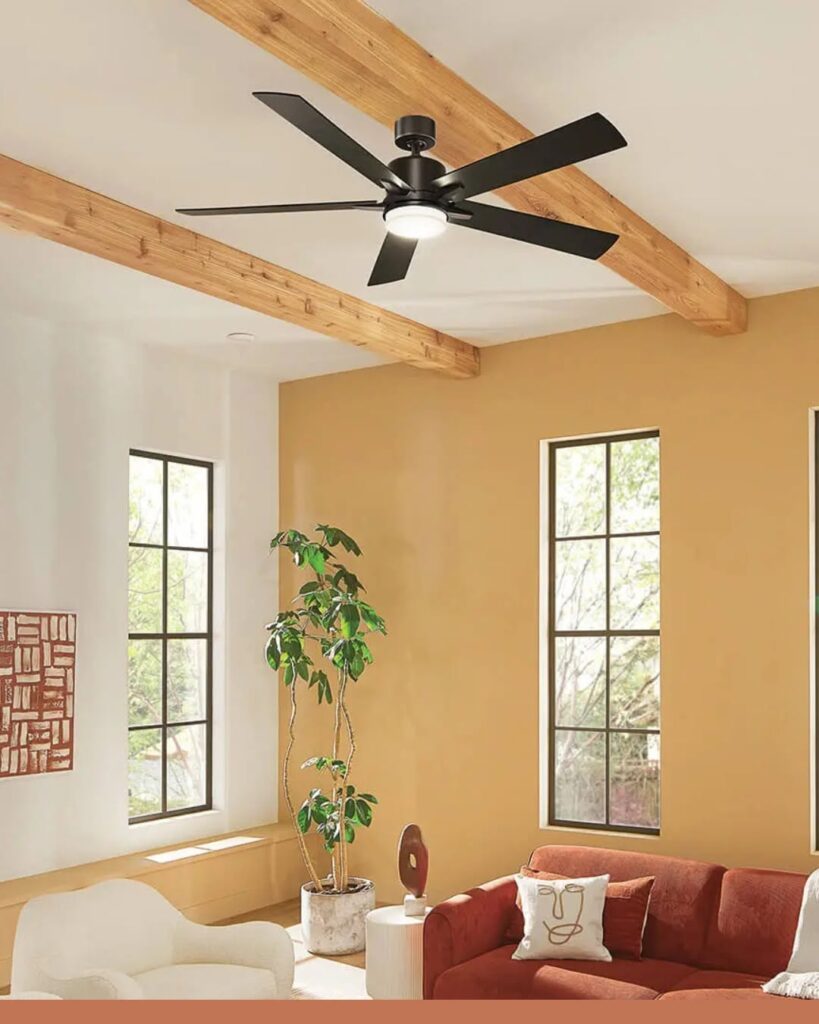
Modern and minimalist fans lean toward clean lines, slim profiles, and integrated LED light sources. They work well in spaces with flat-front cabinetry, matte-black or brushed-nickel fixtures, and minimal ornamentation. Transitional fans are the most versatile option, carrying finishes like bronze, brushed nickel, or matte white that work across a range of design styles without competing with anything else in the room.
Industrial and farmhouse fans bring in exposed hardware and wood-look blades that suit spaces with open shelving, shiplap, or mixed-metal accents. Regardless of style, finish coordination matters. We always recommend matching or intentionally contrasting the fan finish with plumbing fixtures, cabinet hardware, and pendant lighting in the same room for a result that feels considered rather than accidental.
Choosing the Right Fan by Room
Each room has different priorities; the right fan for a bedroom isn’t necessarily the right fan for an open living area or a covered porch.
Here’s how our designers approach each space.
Bedrooms
In bedrooms, quiet motor operation comes first. A fan that hums or rattles at low speed becomes a real problem in a room built around rest. Most standard bedrooms fall within the 42- to 52-inch range. If the room already has an overhead light fixture, a fan without a light kit may be the cleaner choice. If not, an integrated light kit or a fan with an adaptable light allows for layering with bedside lamps.
Living Rooms and Open Spaces
Larger-diameter fans, from 52 to 72 inches, handle open floor plans and great rooms more effectively. In these spaces, the fan also functions as a design anchor, so finish and blade style require more attention. For very large rooms or L-shaped layouts, two fans placed strategically outperform a single oversized unit in both airflow and proportion.
Kitchens and Covered Outdoor Areas
Kitchens with islands or breakfast nooks typically work well with a compact fan in the 42- to 48-inch range. For covered outdoor spaces, a damp-rated fan is the minimum requirement. Areas fully exposed to rain or direct weather need a wet-rated fan built with weather-resistant materials and a sealed motor housing. An indoor-rated fan in either environment will fail well ahead of schedule.
Light Kits, Controls, and Smart Features
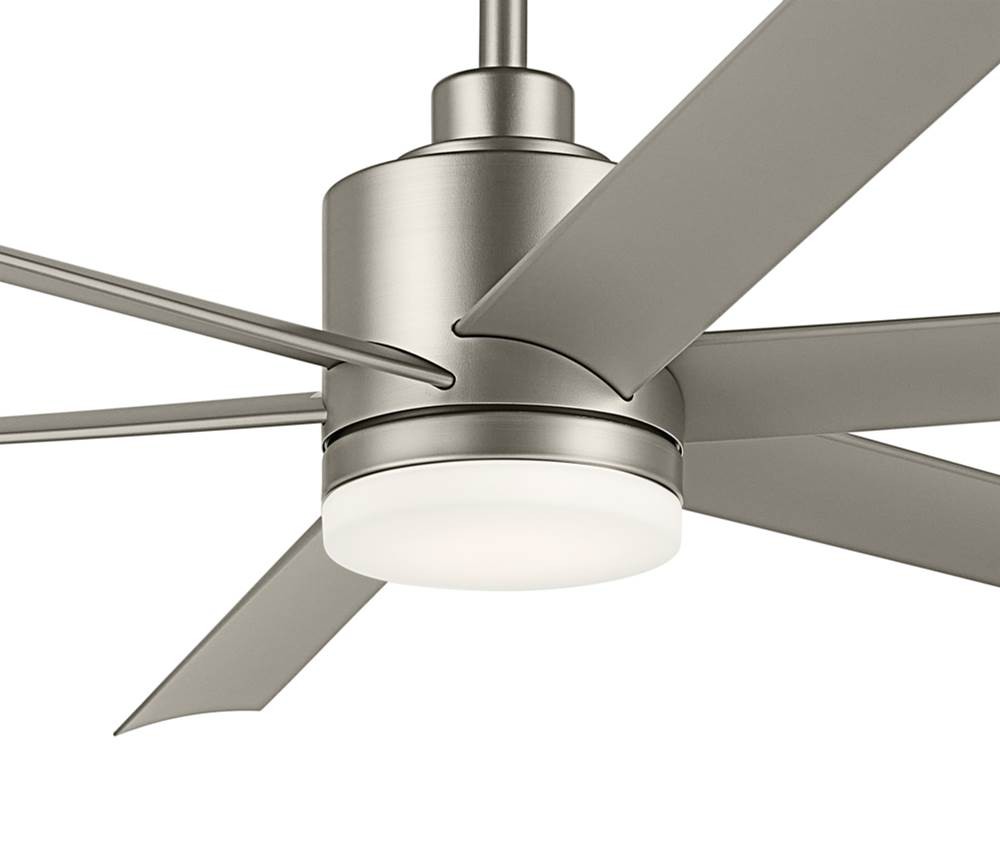
Fans with integrated LED light sources offer a clean look and long-term energy savings. Fans with adaptable light kit options give more flexibility if lighting needs a shift over time. Control configuration is worth deciding early. Remote controls, wall controls, and pull chains each suit different room setups. Pull chains are simple but less practical in high-ceiling installations where reaching them means hunting for a string in the dark.
Smart fans compatible with home automation systems allow adjustments to speed and lighting via voice control or a mobile app. Before purchasing, confirm dimmer compatibility if you plan to use the fan on a dimmer switch, and pay attention to color temperature. A warm white LED fan reads very differently in a bedroom than a cool white option would.
Buy Your Next Ceiling Fan at Bath & Bronze
Choosing the right ceiling fan comes down to finding three things: the right size for the room, the right airflow for the space, and a finish that holds its own alongside the rest of the design. When these three elements align, the fan disappears into the room in the best possible way.
Visit the Bath & Bronze showroom to compare ceiling fan finishes, sizes, and styles in person, or browse our full ceiling fan collection online to start narrowing down your options before you arrive.
Frequently Asked Questions
What size ceiling fan do I need for a 12×12 room?
A 42- to 48-inch fan is the standard recommendation for rooms up to 144 square feet. Ceiling height and furniture scale can slightly shift that range. A room with tall ceilings or heavy furniture may benefit from a 52-inch fan to maintain adequate airflow at the occupied level.
Does blade count affect airflow performance?
Motor efficiency matters more than blade count for actual airflow. A well-engineered three-blade fan will outperform a weak five-blade fan.
Can I use an indoor ceiling fan on a covered porch?
Covered outdoor spaces require, at a minimum, a damp-rated fan. The moisture exposure in those environments is enough to damage motors and finishes rated only for indoor use. Fully exposed areas need a wet-rated fan with weather-resistant materials and sealed components throughout.